PirateDay

  • Subscribe to our RSS feed.
  • Twitter
  • StumbleUpon
  • Reddit
  • Facebook
  • Digg

Thursday, 5 September 2013

Book Review: SPEAKING FROM AMONG THE BONES by Alan Bradley

Posted on 07:00 by Unknown

1) THE SWEETNESS AT THE BOTTOM OF THE PIE

2) THE WEED THAT STRINGS THE HANGMAN'S BAG

3) A RED HERRING WITHOUT MUSTARD

4) I AM HALF-SICK OF SHADOWS

5) SPEAKING FROM AMONG THE BONES

Coming soon:

6) THE DEAD IN THEIR VAULTED ARCHES

As you can see, the titles of award-winning author Alan Bradley's 'Flavia' books are as intriguing, well, almost as intriguing as his main character: an eleven (or possibly twelve) year old prodigy-sleuth with the unlikely name of Flavia de Luce.

I've read them all (except for the last title due out soon, if not already) and never tire of recommending this series set in 1950's England. The English countryside (in and out of fiction) is endlessly fascinating to me so that might have something to do with my affection for these books. But if the writing weren't so top notch and I didn't like Flavia so much, nothing would induce me to keep reading. You know how merciless I can be.

Canadian author Alan Bradley is able somehow to write from the point of view of a precocious eleven year old girl, that in itself is a kind of miracle and a very special talent. But this is no ordinary 'child'. First of all, Flavia is brilliant, second of all she has a penchant for poisons and messing about in an old family laboratory on the top floor of Buckshaw, her family's large ramshackle house. Third of all, she is very adept at solving crimes which occasionally occur in the small village of Bishop's Lacey - a seeming hotbed of murder and nasty doings.

But no matter what mysteries happen around her, Flavia remains a young naive girl, wise in certain ways, but often bewildered by grown-up actions. She is never someone pretending to childhood - her voice is true. She IS a child in many of her thoughts, comments and occasionally her conclusions - but a child who just happens to be a science prodigy. Much to the chagrin of the local constabulary.

It is the 500th Anniversary of the death of Saint Tancred whose bones are buried in a vault within the local village church. Flavia, curious as ever, is anxious not to miss the planned excavation of the saint's bones. Along with her faithful bicycle Gladys, mute witness to all her adventures, Flavia is determined to watch the midnight doings down at the church - a determined Flavia is a small force of nature.

Sneaking around at night is a common enough occurrence for our heroine since she sleeps in a separate wing of the house (near her handy chemistry lab 'inherited' from a great uncle) away from her two older sisters (of whom the less said, the better) and her distracted father, a sad widower who seems only interested in his stamp collection. As a result of her lonely family life in a decaying pile of bricks about to be foreclosed upon (the tax man must be obliged), Flavia is pretty much on her own, left to find her own entertainment. There is an inchoate sadness in Flavia which adds depth to her character and explains some of the willfulness of her behavior. This is a lonely young girl who, nevertheless, is eager and determined to make her existence worthwhile.

So it is not at all unusual that she is on hand in the dead of night when the body of the church organist is discovered in St. Tancred's vault. It's Flavia on the case when no one can figure out how the man was killed or for that matter, why.

With Gladys in tow, the inventive Flavia is off and running.

Now if only Flavia's willfully stubborn father will sell the Shakespearean folio found in his library and pay off the damn taxes on the house! Oh wait, isn't there a jewel that is part of a long-lost de Luce family inheritance? A historic jewel discovered by the dead organist? Hence his untimely death?

The book has a cliff-hanger sort of ending which makes me wish I had the next book clutched in my hot little hands.

This is series that probably should be read in order, though reading the first two will set you up for the rest quite nicely.

Read More
Posted in | No comments

Tuesday, 3 September 2013

Tuesday's Overlooked (or Forgotten) Film: THE WIND AND THE LION (1975) starring Sean Connery and Candice Bergen

Posted on 06:30 by Unknown

THE WIND AND THE LION (1975) was written and directed by John Milius and stars Sean Connery, Candice Bergen and Brian Keith.

I simply cannot be sensible about this film. So pardon me while I gush. I KNOW it's all romantic Hollywood nonsense very loosely based on a little known incident in American/Moroccan history which took place in 1904, but Sean Connery wrapped in a black keffiyeh, cloak and boots, just about makes me swoon.


I don't care that sometimes his Scottish accent is audible. I don't care that his men kill off a bunch of embassy staff in the beginning and kidnap an American woman (widow of a diplomat) and her two children - he has his reasons. I don't care that he chops off a man's head very satisfactorily with a sword - hey, the guy disrespected him - those were brutal times. Believe me, it's all worth it. (In truth, it's not that gruesome.)

You see, I make excuses so that I can continue to enjoy watching this film which remains one of the most romantic movies I've ever seen even if there is not a single love scene in the entire picture.

Not that I think the director, John Milius  (this is the guy who gave us DIRTY HARRY and CONAN THE BARBARIAN after all) - a real man's man from what I hear - intended to make a romantic film. Although you never know. It's possible, I suppose, that Milius was aware that sex and romance are not necessarily synonymous. (Which lots of today's directors and screenwriters seem to have forgotten if they ever knew it at all.)

But my friends, this is Romance on a Grand Scale: This is the Thrilling Romance of Adventure and Derring-Do. The Romance of Mysterious Places, of Dangerous Men Dashing About on Horseback with Flags and Cloaks Flying in the Wind. You get the idea.

Okay, on to the rather confusing plot:

In 1904, Germany, France and the British Empire are all jostling elbows for control of Morocco. The Sultan (played in the film to the arrogant hilt by the wonderful Vladek Sheybal) is apparently, a puppet of Western Imperialism. The relationships here are a little hazy, but it isn't necessary to know all the interlocking ifs ands or buts. However, if you're the sort who worries about that sort of thing, make up your own details.


It is enough to know that the mysterious Berber brigand Mulai Ahmed er Raisuli (Sean Connery) is the leader of a large tribe of insurrectionists who will stop at nothing to embarrass the Sultan of Morocco and start a civil war. (That's the simple explanation.)


To that end, Raisuli's men kidnap beautiful widow Eden Pedecaris (Candice Bergen) and her two children, William and Jennifer, and make off into the desert wilderness, captives in tow.

An aside: According to Wikipedia, the real victims of the Pedecaris incident were a middle-aged man and his stepson - hardly the stuff of legend. The two were returned unharmed.

Raisuli then issues an outrageous demand to the Sultan for ransom, attempting to provoke an international incident.

Okay, that's the basic set-up.

Where the movie really works for me is in the larger-than-life personality of Raisuli (not to mention, his swashbuckling costume). Sean Connery's devilish smile and imperious attitude - he casually steps onto the bent back of a minion to mount his horse - tells you that this is a man who is complete master in his own small universe. A man who, nonetheless, exudes a great deal of almost tangible charm and allure - most especially in the mind of a small boy (Eden Pedecaris's son William) looking for a hero and ready to be impressed by a daring manly-man.

The hero-worship of the boy is developed nicely by Milus and leads to a wonderful moment in a scene done in slow-motion near the end which is very nearly worth the price of admission. It is one of two moments in the film which always make feel kind of swoony and lead to two very satisfactory sighs of contentment.

But I'm getting ahead of myself as usual.

Mrs. Pedecaris (as Raisuli calls her for the entire film) becomes a bur in the side of the brigand leader - a kind of itch he can't scratch. She refuses to kow-tow to Raisuli's overblown sense of importance. She has the temerity to talk back to him and in front of his men. She beats him at chess. How is this woman to be dealt with?


Primarily concerned with the safety of her children and her own dignity, Mrs. Pedecaris remains unflappable during the whole ordeal. This is handled very well by Candice Bergen in one of her better on-screen performances. She is just annoying enough not to be TOO annoying. And of course, she is exquisitely beautiful. (Never hurts.)

Having said all that, she is not immune to Raisuli's charm - I mean, who would be?


She softens towards him, especially when she realizes she and her children are in no real danger from the exasperated brigand. This is driven home when she bribes two of Raisuli's men to help her and the children escape and then finds herself at the villains' mercy out in the middle of the desert.

But all is not lost for who should show up in the dark of night but Raisuli looking very determined if not disgruntled. By himself he quickly dispatches the men - he hasn't even bothered to bring the rest of his crew - and informs Mrs. Pedecaris that she is a lot of trouble - in case she didn't know. He looks so wonderfully in charge, so commanding, so heroic, so....I don't know, SO manly, that you have trouble not responding. And the look on Candice Bergen's face tells you that she's feeling the same way. This is a man to be reckoned with.

Needless to say, young William is mighty impressed with Raisuli as well.

Will Raisuli and Mrs. Pedecaris ride off into the desert and live happily ever after? Of course it can't happen that way, this is not a romance novel, it's just a little bit of a fairy tale with international ramifications. Plus director John Milius is more concerned with the rugged adventure of it all.


Now let's back up a bit and head on over to Washington D.C. where President Theodore Roosevelt (played wonderfully by Brian Keith) is involved in a dicey re-election campaign. The Pedecaris kidnapping seems ready-made for a spot of political propaganda. Roosevelt sees the benefit of intervention - 'Pedecrais alive or Raisuli dead!' It seems a satisfactory way to get the voters' attention as well as a chance for the USA to flex its newly constituted overseas muscle - much to the dismay of Roosevelt's Secretary of State John Hay (John Houston).

When the American consul to Tangier fails to negotiate the release of the widow and her children, Roosevelt orders American troops into the city to either retrieve Mrs. Pedecaris or force the Pasha to pay the ransom. The Pasha acquiesces to Raisuli's demands.


However, the Germans do not take kindly to this interference and when Raisuli shows up to hand over Mrs. Pedecaris and her children, he is betrayed and captured by German and Moroccan soldiers. (This part of the story is rather confusing but somehow, it's never lessened my enjoyment of the film.)

While diplomats haggle and Raisuli hangs upside down from the ceiling by his heels, Mrs. Pedecaris takes matters into her own hands and with her two kids and three rifles, she convinces the American marine contingent (who are rather bored at the lack of action) to help her free Raisuli. The brigand was promised safe passage by Roosevelt if Mrs. Pedecaris was returned unharmed.


As for those two soul-satisfying moments I mentioned earlier, they both occur during the escape. I'm sorry, but you'll have to see the film to see what I'm talking about.


After that, there are fabulous end credits all to the stirring music of Jerry Goldsmith's powerful score.

I've learned recently - from reading Laurie R. King's latest book, GARMENT OF SHADOWS, that the real Raisuli was a conniving blackguard. But as I like to say, nobody's perfect.

For more details on the film's convoluted plot: the Wikepedia page.

Don't forget to check in at Todd Mason's blog, Sweet Freedom, where all the rest of today's forgotten films and/or other visuals will be listed and linked.
Read More
Posted in Candice Bergen, Forgotten Film Tuesday, John Milius, Movies, Sean Connery, The Wind and the Lion | No comments

Monday, 2 September 2013

Prologue

Posted on 11:52 by Unknown

I'm not officially back until tomorrow, Tuesday. (Got a movie post all ready to go.) Today I'm just tinkering and doing some last minute housekeeping with the page. You know me, I'm not happy if I'm not fussing. 

I've had a nice long rest. (Rest from what - you may well ask and I would answer: from stress build-up. I get like that sometimes. But I was also plagued (and I MEAN, plagued) by some very annoying allergy attacks. It was a rough summer.)

I managed to read a lot. I listened to baseball games. I played on Pinterest and just generally did nothing but stay home and putter about. I also spent time with my grandchildren which was the best part of the whole thing.

Hope you're all doing well - I did check in now and then to see what you all were up to - and that you're ready to indulge an old lady's whims once again. I missed you guys.

Artwork at the top of the page by Robert Weber for The New Yorker.

Read More
Posted in | No comments

Tuesday, 9 July 2013

Taking some time off...

Posted on 09:11 by Unknown
Artist: Sally Rosenbaum

It's no secret that I've slowed down in my blogging. No specific reason, just tired. So I've decided to take the rest of July off and see what's what at the end of the month. Not to worry, I'll be back at some point.


Read More
Posted in | No comments

Sunday, 7 July 2013

Sunday Salon: Russian Painter Zinaida Serebriakova (1884 - 1967)

Posted on 13:12 by Unknown
Her first painting to gain accalim, a self-portrait of the young Zinaida. Probably still her most recognized.

 The painter's husband, railway engineer Boris Serebriakov.

Self-portrait with brush.

Self-portrait with two of the painter's children.

Tata with Vegetables 1923

Katya Still Life 1923

In the Kitchen 1923

Self-Portrait

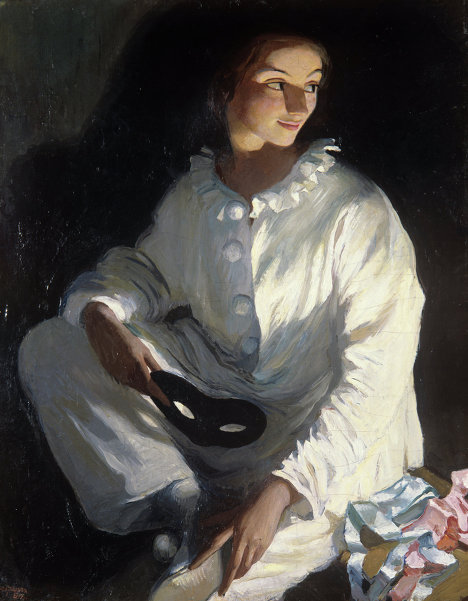
Self-Portrait as Pierrot 1911

At breakfast 1914

House of Cards 1919

Portrait of A.J. Belodorodov 1925

The artist's daughter Katya, 1929

Portrait of Maria Butakova 1931

Katya, the artist's daughter, 1934

Senegalese Soldier 1918

Bleaching Cloth 1917

Harvesting 1915

Ballerina Dressing Room 1923

Ballet Dressing Room 1922

Bather 1911 (Possibly a self-portrait)

Moroccan Woman in White 1928

Bathers on the Beach 1927

Self-Portrait 1907

Zinaida Serebriakova (1884-1967) was a Russian painter - one of the first women to gain acclaim as such - of enormous talent. She came from a well-to-do artistic family and studied art not only in Russia, but in Italy and France as well. She married, had four children - all of whom became subjects in their mother's work.

After the onset of the Russian Revolution in 1917 and her husband's death, the artist and her mother and four children were forced to abandon the family's plundered estate. Interestingly, she then switched for awhile to charcoal, pastel and pencil as these were less expensive mediums than oil paint while she continued trying to earn a living as an artist. I think her pastel work is just as fine as her oils. I love the spontaneous feel of it.

Serebriakova moved her family to Petrograd where she shared an apartment (as was Soviet protocol) with other tenants. Luckily, these tenants were member of the Moscow Art Theater and Serebriakova was able to focus her work on theater life.

In 1924 Serebriakova received a commission to paint a mural in Paris. She went to France, planning to return to Russia (then the USSR) but was unable to. She was allowed to send for her two younger children, but was not able to see her older two for many years - she would not see her daughter Tatiana for another 36 years.

In the meantime, Serebriakova took French citizenship in 1947. She died in 1967 and is buried in the Russian Cemetery at St. Genevieve des Bois.

Zinaida Serebriakova's work is extraordinary in that the artist, despite what must have been difficult years of separation from two of her children, appears to concentrate on the beauty she was still able to find in life, in the people she came in contact with in her travels.

Though some paintings of her children seem filled with symbolism, they are not so heavily loaded down that it interferes with the artist's incredible technique and finesse of movement and design. Her work is instantly recognizable, most especially those self-portraits which show a beautiful, young and self-assured young woman gazing out at the world.

To learn more about Zinaida Serebriakova and see more of her work, please use this link. See also this link.


Soviet stamp honoring Zinaida Serebriakova - 1988
Read More
Posted in | No comments

Tuesday, 2 July 2013

Tuesday's Overlooked (or Forgotten) Film: I'VE ALWAYS LOVED YOU (1946) starring Philip Dorn and Catherine McLeod

Posted on 07:30 by Unknown


This is the oddest fairy tale film, the type of romantic blah-blah (and not in a bad way) they just don't make anymore. (Well, you can tell that from the title.) In certain ways it's a disturbing sort of story, but it soon catches you up and spins you along in a kind of whirlwind similar to that which overtakes the heroine in the film.

I'VE ALWAYS LOVED YOU pretends to take place in the 'real' world of eccentric musical genius, but is instead a soap opera that actually takes place in a kind of never-never land. The minute you see the still gorgeous Technicolor (production design by Ernst Fegte with Franz Cugat as associate color director) you'll know right away that you're not in Kansas anymore. So to speak.


Academy Award winning director Frank Borzage is at the helm and the screenplay was written by Borden Chase (who later wrote the classic, RED RIVER).  The stars are Philip Dorn, Catherine McLeod and Bill Clark.  Not exactly actors with household names it's true, but the film is out of Republic Studios. Remember them? This is one of the rare color films from that very budget conscious studio more used to churning out black and white detective noir, serials or cowboy shoot 'em ups.

The story is secondary to the spectacular classical music played throughout (dubbed by virtuoso Arthur Rubinstein) which is meant to convey the highs and lows of the characters emotions in a rather direct way.

Philip Dorn plays Maestro Leopold Goronoff, an emotional, egocentric genius, world famous pianist and conductor whose peripatetic life is seemingly governed by whim. Early on he is introduced to the daughter of an old friend, a former concert pianist who gave up the touring life to settle on a gorgeous farm in Pennsylvania and raise a family, something Goronoff decries. Of course the daughter is not only a spectacular pianist she is also beautiful and in love with a local farm boy named George (Bill Carter) who says she's the 'best piano player I ever heard'.


Myra Hassman, the daughter, is played by Catherine McLeod. Her father Frederic Hassman is played by the wonderful Felix Bressart though it's hard to imagine him as a former concert pianist. Father and daughter seem to lead an idyllic life down on the farm until the great maestro drops by. (He'd heard Myra play at an impromptu audition in New York)  Goronoff has decided that Myra will be his protegee. (He climbs in through a window - he's eccentric, you see.) And what Goronoff wants Goronoff gets. That sort of thing.

After hanging around the farm for awhile teaching Myra the ropes of being a musical whiz, he insists she will travel around the world with him while he continues to hone her musical brilliance. Myra says, 'okay'. Myra's father has a talk with the Maestro (as well he should) then allows his daughter to head out into the world - all for the sake of music.

And boy do we get music, glorious music, heaps and heaps of Rachmaninoff, Beethoven, Mozart, you name it. All beautifully and powerfully played by the great Arthur Rubinstein. All used by the two main characters in the film to express the Sturm und Drang of being finely tuned musical geniuses seething with emotions.

It's all pretend Europe, pretend South America, pretend New York, pretend Pennsylvania farm all photographed in lovely tones of make-believe color. (My favorite set was the villa in Rio de Janeiro.)


As for the actors themselves, I have to say that Philip Dorn is a total hambone. He plays the womanizing Maestro to the hilt. Leopold Goronoff to the 'nth' degree. He means to outshine any and every musician/maestro ever seen on the silver screen. And he has the heavy accented speech (he is either Czech or Hungarian) which makes most everything he says sound as if he's starring in a 19th century operetta (minus the singing).

Dorn is all artificial mannerisms and physical implausibilities (his conducting movements are laughable) meant to show that except for his complete devotion to music he is the free-est of spirits. He has a gusto for life and the ladies which doesn't slacken even with young Myra in the household as his protegee. In fact his absolute determination to enjoy life gets wearying after awhile - if I were Myra I'd be exhausted  just watching from the sidelines. But having said all that, I still liked him. It is almost impossible not to. At least in the first half of the film.

Goronoff's grandmother (Babushka) is played delightfully by my favorite old lady with an accent: Maria Ouspenskaya. She is a tiny little thing who is charmingly, adorably homely and steals every scene she's in. Strangely, she decides to nickname Myra the prodigy, 'Butterball'. Yes, makes no sense, but that's what Madame Goronoff calls Myra from the moment she meets her. No, Myra is not fat, nor does she resemble a turkey.

In the beginning, Catherine McLeod seems a bit too old to be playing the part of the devoted young girl who quickly falls under the spell of the great Maestro to the point that when her father passes away back in Pennsylvania, she does not even attend his funeral. (Very, very odd that. To think that his old friend Goronoff AND his only daughter don't immediately head back upon learning the news. Even funnier,  Myra doesn't even tell Goronoff of her father's death though he walks in on her just moments after she's read the news in a letter from George, the faithful boy she left behind on the farm. This seems to be a script oversight bordering on the bizarre considering the supposed closeness of Myra and her father.)

Instead they (with grandmother in tow) had to New York City and Carnegie Hall. (NYC is only a few hours away from Pennsylvania. I make no further comment on this peculiar incongruity.)

Music in this film is used to enlarge the emotions of Goronoff and Myra (not that his need any more enlarging). They each speak and emote with each other through their music, almost on a telepathic level. Goronoff has a pet theory, he insists that all music is male oriented, meant to showcase male emotions. (?!) There are no women in music. He means the music itself not the playing of it, since obviously Myra is a woman. She, naturally enough, is taken aback by this, but seems to accommodate the notion well enough.

Goronoff continues throughout most of the film to treat Myra as if she were a devoted school girl whose sensibilities border on the gauche. He purposely refuses to acknowledge her femaleness - for lack of a better world.  He 'courts' his sophisticated women in full view of Myra and seems to have no idea that this behavior might annoy her. It simply doesn't occur to him (at least then) that Myra is more than the sum of a Rachmaninoff concerto.

Back in New York, Myra gets her first official concert with Goronoff conducting the Rachmaninoff. The concert itself becomes a kind of musical duel played out in full view of the audience which includes George, the boy Myra left behind, sitting up in the balcony.

Emotions are laid bare but afterwards Goronoff explodes and accuses Myra of mimicking his style, of trying to show him up, of attempting to be greater than The Maestro. How dare she?! He tells her to go back home and out of his life.


She does just that and shortly thereafter marries George, yes, yes, the boy she originally left behind. Though she warns him that she might not love him in the same way he loves her. Years go by quick as a wink soon enough, Myra and George have a daughter who, in turn, has musical talent. No big surprise there.

Finally Myra (who has not seen or heard from Goronoff or made any attempt to continue her own playing) feels she must face The Maestro once more. This time for the sake of her daughter and her marriage. She wants the Maestro to put the seal of approval on her daughter's talent. She also wants to prove to George and to herself that the Maestro no longer means anything to her.

Bill Clark as George, the long suffering but eternally patient and understanding husband is kind of a blah personality - I suppose he is meant to appear in stark contrast to the bombastic Goronoff.. Clark is necessarily in many scenes in the second half of the film and it just goes to showcase that in spite of his friendly farm boy demeanor, he is not a very good actor.

I won't say how it all ends but I will say that the first half of the movie is significantly more interesting than the simplistic second in which we are brought down to earth with the thud of banal reality. But we get to hear the Rachmaninoff again and as I like to say, too much Rachmaninoff is never enough. The ending feels flat and rather forced after all the angst that has gone before, but I suppose it had to be.

Despite ALL THAT, I still recommend the film. I'm quirky that way.

I'VE ALWAYS LOVED YOU did call to mind another film with a young woman under the spell of an overbearing musical Svengali - it starred James Mason. But I've forgotten the title though I've tried for years to find it.

Don't forget to check in later at Todd Mason's blog, Sweet Freedom to see what other overlooked or forgotten films other bloggers are talking about today. You just never know what you might find over there.

Read More
Posted in Catherine McLeod, Forgotten Film Tuesday, Maria Ouspenskaya. I'LL ALWAYS LOVE YOU. Movies, Philip Dorn | No comments

Sunday, 30 June 2013

Who's That Knocking at the Door? - Flash Fiction Challenge Answered

Posted on 07:26 by Unknown

Okay, here's my response to my own self-imposed Flash Fiction Challenge inspired by my current blog banner, an illustration by the great Mario Cooper. I hope you enjoy it. There might be a  couple of other posts whose links I'll add below. If you've written something, please let me know and I'll add the link. Don't let's hide your light under a bushel.

In the meantime, you can luxuriate in mine. (Then link over to Dorian's and John's)

I really do enjoy writing this sort of thing. The result is for you to judge, but I definitely think I should do more of it. Why? Well, because it's fun.


Tales of the Easily Distracted: 'Life's A Beach' by Team Bartilucci

Pretty Sinister Books: 'The Terrible Thing at the Edge of the Lake' by John

********************

A  barrage of loud thuds shook the heavy wooden door.

‘Oh dear, oh dear, oh dear, “ said Miss Pruett on the verge of tears.

“One more ‘oh dear’ and I will not be responsible for my actions,” said Joe Kirby, grunting as he quickly shoved the second lock into place, hoping the door would hold for awhile.

“Dear me…”

“No, no, dear me is as bad as ‘oh dear', Miss Pruett. May I suggest that you dispense with the ‘dears’ for the time being? It’s hot as hell in here and I’m damned if …”

“Mr. Kirby, please. My nerves are in a dither and I hardly know what I’m saying.”  

Despite her protest, Selma Pruett couldn’t help but observe yet again, that her employer’s body-guard was very tall, very blond, very muscular and very tanned. What’s more, his moist body exuded a manly smell not unlike her favorite saddle. Not many men smelled this good while in an agitated sweat. 

"Your language leaves much to be desired as well,” she added after a few seconds of primary confusion brought on by the combustible mix of male testosterone and female hormones. Inevitable, she supposed, given the intensity of their situation. They were under siege, surrounded by a dangerous enemy bent on tearing them limb from limb.

Kirby stepped back from the door. “I beg your pardon, did you actually say ‘dither’?”

“My goodness Mr. Kirby, one would think you had never heard the English language spoken aloud before.” The moisture lurking in her eyes evaporated. “At least I am not  ‘helling’ and ‘damning’ all over the place.”

Of all the women in all the world he had to be trapped with a strait-laced librarian. Heaven help me, thought Kirby, trying to refrain from kicking at the door. He was in definite danger of being overcome by a fit of extreme pique. 

Instead he made a curt bow. “Pardon me for losing control of my vocabulary, Miss Pruett. I don’t know what came over me. “

“Possibly fear of being mauled to death,” she said, trying to be helpful. Their current situation made impertinence almost mandatory.

“So you do have a sense of humor. Thank God. I’d hate to be caught on the brink of eternity with someone who had no sense of the rightness of things. “

The unnerving sounds of scratching, thudding and growling increased. A large enraged body began slamming against the other side of the door.  "I’d hoped they’d forgive and forget, but it seems not yet,” said Kirby. “My apologies, Miss Pruett. It seems we’re in for it.”

“Oh dear….” she said, still slightly bemused by his appearance. Surely someone who looked so much like the heroes in her favorite books couldn’t help but actually be a hero. If only she could stop acting like the fluttering heroine. If only the cottage came equipped with a telephone. If only she’d hadn’t had the notion of heading out on the lake by herself. If only she’d turned down this job. If only the door would hold.

“I do wish you hadn’t broken the chair," she said.

He leaned against the door. “Yes, yes, I admit it all. I behaved like a berserker.”  

"What on earth were you thinking Mr. Kirby?”

“Actually I don't think I was thinking at all, Miss Pruett.  Maybe I was simply crazed with hunger."

She made no reply.

 “Look I know this is all my fault,” he said defensively. "But you definitely shouldn’t be here. Not that I mind the company, of course.”

“Who are are you, Mr. Kirby? I mean, who are you - really?” she heard herself asking - a question that had plagued her since her arrival at the mainland country estate of her reclusive employer: an eccentric peer with a vast library which needed cataloguing. Was it only a week ago? At the moment, it seemed like ages. “Why a live-in body-guard? Lord Barrow rarely steps out in public."

“Rich men make enemies, Miss Pruett. But at this moment, it looks as if I’m the soon to be ex-body guard of a rich man with a low tolerance for practical jokes. He’s bound to think all this some sort of joke that backfired. Unfortunately, he has no sense of humor.”

The outside assault upon the door continued. Accompanied now by ferocious chortling and an ominous creaking of wood.

Kirby slammed a palm on the door in frustration. "I was hungry.. I came in here after my swim, just to look around, you know how it is. And I found three bowls of fresh porridge, still steaming.  I suppose I lost my head."

After a moment, amazed that she could keep her composure and unable to hold back a rueful smile, she said, “ I guess I picked the wrong morning to take a cruise on the lake.”  

He checked the locks unsure how much longer they would hold. The shoving and growling now combined intermittently with the rattling of the wooden shutters which thankfully they'd had the presence of mind to shut and bolt earlier. "All this fuss over porridge," he said. "Hard to believe."

"I feel as if I'm having an out of body experience, Mr. Kirby," she said.

"Didn’t the old man warn you to keep away from the island?"

She crossed her arms. “I hadn’t planned on running out of fuel. It’s such a pretty little lake. Such a hot day."

“Barrow doesn't come here very often. It’s an odd sort of place, Miss Pruett."

“No. Really? So what were you doing here?” she asked. "Besides foraging."

He shrugged. “An impulse. I swim most mornings, saw smoke coming from the chimney, decided to take a look. What about you?"

She moved away from the door. “ Well, the boat began drifting over and when I saw the cottage I walked up to see if they might have a telephone,” she said. “ Silly, I know, since they have no use for the thing. But there was nobody home. I tried the door, found it unlocked, let myself in, went exploring and found you sleeping upstairs in a rather large bed. Aren't you a little young to be taking midday naps?”

“I was replete.” He said, grinning. But looking into her worried blue eyes, Kirby lost his train of thought. Up close and without her ubiquitous glasses, Miss Pruett was definitely not Miss Mousey. Wasn’t that always the way?

 “Yes, I know, I did a stupid thing,” he said after a moment. “ But the bed looked so comfortable.” He gave the door a last frustrated shove. “I like a feather bed.” There was just no way to explain this to the old man, he thought. Not any rational way.

“You snore,” she said. “That’s what drew me upstairs.” She looked up at the skylight. “Maybe we can get out that way.”

“Yes, all you have to do is climb up on my shoulders and I’ll catapult you up to the ceiling. And then what?”

“Did you HAVE to eat ALL the porridge?!” She suddenly blurted in frustration. “Even what was left in the pot?"

"I got carried away. It was very good porridge. Reminded me of my mum’s."

"Mr. Kirby, really. I begin to despair."

"All right, all right,  no point in overreacting. Here’s what I’m going to do,  I’m going to open the door and let Poppa Bear in and then we’ll see what’s what. You go stand behind the sofa. Try not to look so threatening. He’s usually a pretty calm fellow. It’s Momma Bear we have to watch out for. She’s a terror. But I think she may be getting tired.”

The racket at the door stopped. “Right on cue,” said Kirby.

Miss Pruett stared, eyes wide.

"You mean you knew this all along? Please explain, Mr. Kirby."

"Look, after all we've been through this morning, life and death and all of it, don’t you think you could call me Joe?

“Joe.” She said, hesitating as if tasting the name on her tongue.

He attempted an encouraging smile.

But - “I'm waiting for an explanation, Mr. Kirby .”

He sighed. “Momma Bear is a very possessive sort. But a damn fine cook. She likes to make a fuss, put on a show. But her anger is usually short-lived.” He looked a bit shame-faced. “ I...uh, I’ve run into them once or twice before. Baby bear is a cute enough little fellow even if he is a bit of a brat."

Why didn’t you tell me this in the first place?

“Well, there’s really no accounting for bears. I could be wrong.”

Oh, Mr. Kirby,” she said, shaking her head.

 “I’d better let them in,” he said. 

Read More
Posted in | No comments
Newer Posts Older Posts Home
Subscribe to: Posts (Atom)

Popular Posts

  • A Museum Exhibition: The Art of American Illustrator Ezra Jack Keats (1916 - 1983)
    Manhattan's Jewish Museum is currently running an exhibition featuring the ground-breaking work of Ezra Jack Keats, children's book...
  • Tuesday's Overlooked (or Forgotten) Film: THE MAN FROM SNOWY RIVER (1982) starring Tom Burlinson and Kirk Douglas
    THE MAN FROM SNOWY RIVER (1982) is a film directed by George Miller based on a poem by A.B. 'Banjo' Patterson and written by Fred ...
  • BABE (1995) starring James Cromwell
    Today is the first day of DOGATHON (February 19th - 22nd)  and I'm happy to join in the fun with my post on one of the best films about ...
  • International Talk Like A Pirate Day!
    Artwork for CAPTAIN BLOOD by N.C. Wyeth Best. Pirate. Book. Ever Second. Best. Pirate Book. Ever. Best. Pirate. Movie. Ever. (This is the Fr...
  • Tuesday's Overlooked (or Forgotten) Film (or Whatnot): Hercule Poirot Gets A Toothache and the Sniffles.
    Today is Overlooked (or Forgotten) Film (or Whatnot ) Day. I add the 'whatnot' because today I don't have a film, I have 'w...
  • Tuesday's Overlooked (or Forgotten) Film: I'VE ALWAYS LOVED YOU (1946) starring Philip Dorn and Catherine McLeod
    This is the oddest fairy tale film, the type of romantic blah-blah (and not in a bad way) they just don't make anymore. (Well, you can t...
  • Forgotten Book Friday: A CIVIL CONTRACT, LADY OF QUALITY and THE CONVENIENT MARRIAGE by Georgette Heyer
    I doubt those of us who love Heyer would have forgotten her books, but it is hard to remember all the individual titles since she was a very...
  • Saturday Salon on Sunday: American artist Sally Storch
    When it comes to contemporary American artist Sally Storch's work, I can't be sensible - I love her paintings. Yes, her style is sim...
  • Overlooked (or Forgotten) Film Tuesday: GARGOLYLES (1972) starring Cornell Wilde, Bernie Casey, Jennifer Salt and Scott Glenn
    Don't know why I suddenly had the urge to see this low-budget TV movie once again (after not having seen it in many years), actually I d...
  • Tuesday's Overlooked (or Forgotten) Film: THE V.I.P.s starring Elizabeth Taylor, Richard Burton, Louis Jourdan, Maggie Smith, Margaret Rutherford, Rod Taylor and Orson Welles.
    The V.I.P.s is a film directed by Anthony Anquith and written by Terence Rattigan, starring Elizabeth Taylor, Richard Burton, Louis Jourdan...

Categories

  • ' Review
  • 'Distemper
  • 'The Gossips'
  • 10 Favorite Still Life Paintings
  • 10 Great Female Portraits
  • 10 Male Portraits
  • 10 Paintings of Children
  • 10 Romance Novels
  • 100 Favorite Mysteries and/or Thrillers
  • 11/22/63 by Stephen King
  • 7X7 Link Award
  • A Christmas Carol
  • A Civil Contract
  • A Deceptive Clarity
  • A Favorite Painting
  • A Good Morning Christmas Picture.
  • A Morning Christmas Painting
  • A Tragedy at Midnight
  • Aaron Elkins
  • Abbott and Costello
  • Ace Atkins
  • Adam Dalgliesh
  • Adriaen van de Venne
  • Agatha Christie
  • Agatha Christie Carnival
  • Alan Bradley
  • Albert Nobbs
  • Alexander Siddig
  • Alexis Smith
  • All of Me
  • All That Heaven Allows
  • All The Wrong Questions
  • Alphabet Hicks
  • Amahl and the Night Visitors
  • Amanda Quick
  • American Impressionism
  • Anastasia
  • Anatomy of Murder
  • Anders Zorn
  • Andy Lao
  • Angela Lansbury
  • Angels and Insects
  • Ann Miller
  • Arabella
  • Archie Meets Nero Wolfe
  • Arsenic and Old Lace
  • Art
  • art mystery
  • Art Opinion
  • Audible books
  • Babe
  • Ballet
  • Baseball paintings
  • Basic Black
  • Basil Rathbone
  • Beekeeping for Beginners
  • Bela Lugosi
  • Benjamin Black
  • Bernie Casey
  • Best Book Covers 2011
  • Best Political Movies
  • Beth Saulnier
  • Bette Davis
  • Betty White
  • Bill Smith and Lydia Chin
  • Birthday
  • Bleak House
  • Bloodhounds
  • Blucher
  • Bob Hope
  • Bob Tarte
  • Bodies in A Bookshop
  • Bonita Granville
  • Book Bags
  • Bookplates
  • Books about animals
  • Booky Themes
  • Bosley Crowther
  • Brandon Long
  • Breakfast at Madeline's
  • Breast Cancer Awareness
  • Brokeback Mountain
  • Bryant and May
  • Bulldog Drummond
  • Cairo Time
  • Candice Bergen
  • Carl Larsson
  • Carol Lea Benjamin
  • Cary Grant
  • Cat and Mouse
  • Catherine McLeod
  • Catherine Nolin
  • Catrin Weitz-Stein
  • Cecil B DeMille
  • Cecil Beaton
  • Champagne For One
  • Character actors
  • Charles Dickens
  • Charles Grodin
  • Charlie Chan
  • Charlie Chan at the Olympics
  • Charlie Chan at the Wax Museum
  • Cherry Ames
  • Chris Norgren
  • Christianna Brand
  • Christine Lefuente
  • Christmas cartoons
  • Christmas illustrations
  • Christmas in New York
  • Christopher Fowler
  • Claudette Colbert
  • Cleopatra
  • Clifton Webb
  • Comfort Reading
  • Conrad Veidt
  • Contraband
  • Cookbooks
  • Cornell Wilde
  • Cotillion
  • Cottage to Let
  • Cynthia Peale
  • Cyril Hare
  • Dancing at the Harvest Moon
  • Dane Clark
  • Daniel Day-Lewis
  • Daniel Silva
  • Danish painter
  • Dark Passage
  • Darkness At Pemberley
  • Dave
  • David Strathairn
  • Dead Man's Watch
  • Deanna Durbin
  • Death Comes To Pemberley
  • Demetrius and the Gladiators
  • Dennis O'Keefe
  • Dermot Morrah
  • Dick Francis
  • Dinah Fried
  • Disney
  • Dodsworth
  • Dogs in Art
  • Donald Westlake
  • Doppelgangers in Paint
  • Dorothy Lamour
  • Douglas Sirk
  • Down To the Zoo and Back Again
  • Dracula
  • Dutch Golden Age
  • Dylan Schaffer
  • Eclectic Christmas Presents
  • Eddie Redmayne
  • Edith Wharton
  • Edward Henry Potthast
  • Edward Hopper
  • Eleanor Fortescue Brickdale
  • Eleanor Parker
  • Elizabeth Peters
  • Ellery Queen
  • Ellery Queen. The Roman Hat Mystery
  • Elvis Cole
  • Emma Bridgewater
  • Emma Dunbar
  • Emmet Otter's Jug-Band Christmas
  • Endeavour
  • English History
  • English mystery
  • Enid Blyton
  • Enslaved By Ducks
  • Eric Marbius
  • Ernest Borgnine
  • Ethan Frome
  • Etsy
  • Everything Stops for Tea
  • Evidence of Blood
  • Ezra Jack Keats
  • Farewell
  • Father's Day
  • Favorite Art Mysteries
  • Favorite Mystery Television Shows
  • Favorite Twenty Books 2011
  • Feeling Good
  • Felicity House
  • Fictitious Dishes
  • Fifty Favorite Film Mysteries and/or Thrillers
  • Final Curtain
  • Five Best Mystery Series
  • Five Favorite Books
  • Flash Fiction Challenge
  • Football paintings
  • Foreign Film Poster Friday
  • Forgotten Book Friday
  • Forgotten Film Tuesday
  • Fowl Weather
  • Frank Langella
  • Frankie Thomas. Nancy Drew Reporter
  • Franz Dvorak
  • Frederic Dannay
  • Frederic Marsh
  • Frederica
  • Friday Book Bag
  • Friday's Book Bag
  • Friday's Child
  • Friday's Foreign Film Poster
  • Friday's Forgotten Book
  • Friday's Forgotten Books
  • Fridays Forgotten Books
  • Fritz Eichenberg
  • Gabriel Crowther
  • Gargoyles 1972
  • Gene Wilder
  • George Booth
  • George C. Scott
  • Georges Simenon
  • Georgette Heyer
  • Gerard Butler
  • Gertrude Elliott Espenscheid
  • Ghost Hero
  • Gideon Fell
  • Gig Young
  • Ginger Rogers
  • Glenda Jackson
  • Glenn Close
  • Gloria Stuart
  • Gold Diggers of 1933
  • Goldfish in art
  • Good Morning Christmas Picture.
  • Graig Kreindler
  • Great Art
  • Green For Danger
  • Guy Carleton Wiggins
  • Halloween reading
  • Halloween.
  • Harriet Westerman
  • Heights
  • Helen Hayes
  • Henri Le Sidaner
  • Henry Mancini
  • Henry Wilcoxon
  • Hercule Poirot
  • Highly Dangerous
  • Historical Suspense
  • Holiday
  • Holiday Gift Guide
  • Holiday Reading
  • Hopscotch
  • Hot in Cleveland
  • House of Flying Daggers
  • House of Wax
  • How To Be A Bad Birdwatcher
  • Humphrey Bogart
  • Hurricane
  • I Am Half-Sick of Shadows
  • I Wanna Hold Your Hand
  • Ides of March
  • Illustration
  • Imogen Robertson
  • Independence Day
  • Ingrid Bergman
  • Instruments of Darkness
  • Island of Bones
  • J. C. Leyendecker
  • J. Robert Janes
  • J.C. Leyendecker
  • Jack Aubrey
  • Jack Buchanan
  • Jack Reacher
  • Jackie Robinson
  • Jacqueline Bisset
  • James Neil Hollingsworth
  • James Ormsbee Chapin
  • James Tissot
  • Jane Austen
  • Jane Eyre
  • Jean Leon Gerome
  • Jeff Hoke
  • Jennifer Salt
  • Jim Henson
  • Jo Dereske
  • Joan Aiken
  • Joan Blondell
  • Joan Collins
  • Joan Crawford
  • Joan Fontaine
  • Joan Hickson
  • Joanne Woodward
  • Joaquin Sorolla
  • Joe Pike
  • Joel Kinnaman
  • John Clarkson
  • John Dickson Carr
  • John Gannam
  • John Milius
  • John Singer Sargent
  • John Thaw
  • John Vivyan
  • John William Waterhouse
  • John Williams
  • Johnny Weissmuller
  • Jon Hall
  • Jonathan Kellerman
  • Josephine Tey
  • Judy Bolton
  • Judy Dench
  • Judy Garland
  • Julius Caesar
  • Katherine Hepburn
  • Kenneth Branagh
  • Kevin Kline
  • Keye Luke
  • Kim Novak
  • Kiss Me Kate
  • Kitty Cornered
  • Lady of Quality
  • Lady On A Train
  • Land of the Pharaohs
  • Larraine Day
  • Laurie R. King
  • Lawrence Alma-Tadema
  • Lee Child
  • Lemony Snicket
  • Lennart Helje
  • Leon Bakst
  • Library Loot
  • Lily Tomlin
  • Lincoln
  • Lists
  • Louis Ritman
  • Louise Camille Fenne
  • Lullaby
  • Lynn Shepherd
  • M.M. Kaye
  • Maigret
  • Maigret and the Madwoman
  • Maigret and the Wine Merchant
  • Manfred Lee
  • Marc Lawrence
  • March of the Wooden Soldiers
  • Margaret Lockwood
  • Margaret Rutherford
  • Maria Ouspenskaya. I'LL ALWAYS LOVE YOU. Movies
  • Marie Louise Elizabeth Vigee-Lebrun
  • Mario Cooper
  • Marius Goring
  • Mark Briscoe
  • Mark Rylance
  • Mark Terry's Facsimile Dust Jackets
  • Marlon Brando
  • Martha Grimes
  • Martin Johnson Heade
  • Mary Astor
  • Mary Astor Blogathon
  • Mary Balogh
  • Mary Hartman
  • Mary McDonnell
  • Mary Roberts Rinehart
  • Mary Russell
  • Matt Witten
  • Maureen O'Sullivan
  • Maurice Brazil Prendergast
  • Maurice LeBlanc
  • Maurice Quentin de la Tour
  • Maurice Sendak
  • Megan Abbott
  • Melody Lane
  • Michael Crichton
  • MIchael Gruber
  • Michael McKean
  • Michael Rennie
  • Michael Sowa
  • Michelle Williams
  • Middle of the Night
  • Midnight In Paris
  • Midnight Is A Place
  • Midsomer Murders
  • Might As Well Be Dead
  • Mireille Enos
  • Misdemeanor Man
  • Misery Bay
  • Miss Peregrine's Home For Peculiar Children
  • Miss Zukas
  • Mission Impossible TV Series
  • Mona Lisa
  • Monkeewrench
  • Morse
  • Mouse Hunt
  • Movie Quiz
  • Movie Thrillers
  • Movies
  • Movies set in New York City
  • Mr. Lucky
  • Murder She Said
  • Museum of Lost Wonder
  • Music
  • Mustaches
  • Mxyplyzk
  • My Week with Marilyn
  • Mysteries
  • Nancy Drew
  • Naomi Novik
  • Napoleon
  • Nathan Lane
  • National Library Week 2012
  • Nemesis
  • Nero Wolfe
  • Netflix
  • New Yorker Christmas Covers
  • Ngaio Marsh
  • Nicholas Kilmer
  • Nina Simone
  • Norman Rockwell
  • Nutcracker Suite
  • Oliver and Hardy
  • Olympic posters
  • Orson Welles
  • Owen McKenna
  • P.D. James
  • P.J. Tracy
  • Paris Breakfast
  • Partners in Crime
  • Pastel portraits
  • Pastels
  • Patricia Clarkson
  • Patrick O'Brian
  • Paula Marantz Cohen
  • Peculiar Crimes Unit
  • Peter Cushing
  • Peter Cushing Centennial Blogathon
  • Peter Lovesey
  • Philip Dorn
  • Pietro Antonio Rotari
  • Powell and Pressberger
  • Pre-Raphaelites
  • Pride and Prejudice scarf
  • Queer Film Blogathon
  • Quirke
  • Quote for the day
  • Quote for the day.
  • Ralph Fasanella
  • Ralph Richardson
  • Ransom Riggs
  • realist paintings
  • Reed's Promise
  • Regency Romances
  • Reginald Marsh
  • Rennie Airth
  • Republic films
  • Review
  • Review Mystery Reading Challenge 2012
  • Rex Stout
  • Richard and Frances Lockridge
  • Richard III
  • Richard III Skeleton
  • Richard Jury
  • Richard Plantagenet
  • River of Darkness
  • Robert B. Parker
  • Robert Donat
  • Robert Goldsborough
  • Robert Henri
  • Robert Parker
  • Roderick Alleyn
  • Roger Duvoisin
  • Ronald Colman
  • Roy Marsden
  • Ruth Chatterton
  • S.J. Rozan
  • Safety Not Guaranteed
  • Sally Field
  • Sally Storch
  • Saturday Salon
  • SAYONARA
  • Sean Connery
  • Seascapes
  • Secret of the Blue Room 1933
  • Seven Days in May
  • Shakespeare
  • Sherlock Holmes
  • Short Story Challenge
  • SHOT by Parnell Hall
  • Sidney Toler
  • Sigourney Weaver
  • Silly Symphonies
  • Silver Streak
  • Simon Barnes
  • Sinclair Lewis
  • Sir William Orpen
  • So Many Steps to Death
  • Son of Frankenstein
  • Spencer Quinn
  • Spenser
  • Spinsters in Jeopardy
  • Spy Thrillers
  • Stephen Maturin
  • Steve Hamilton
  • Steve Martin
  • Summer Reading
  • Sunday Salon
  • Superintendent Maigret
  • Superman
  • Susan Branch
  • Susan Hayward
  • Sydney Greenstreet
  • T.H. White
  • Tahoe Trap
  • TAKEN
  • Takeshi Kaneshiro
  • Tamara de Lempicka
  • Tarzan and His Mate
  • Television
  • Temeraire
  • Ten Best Books 2012
  • Thanksgiving
  • That Touch of Mink
  • The Adventures of Tartu
  • The Black Stallion
  • The Cat and the Canary
  • The Chinese Orange Mystery
  • The Convenient Marriage
  • The Dana Girls
  • The Daughter of Time
  • The Death of Colonel Mann
  • The Dog Who Knew Too Much
  • The End of Everything
  • The French Powder Mystery
  • The Grand Sophy
  • The Great Films
  • The Hard Way
  • The Hardy Boys
  • The Harvey GIrls
  • The Hollow Needle
  • The Hound of the Baskervilles
  • THE HUNT FOR RED OCTOBER
  • The Invention of Hugo Cabret
  • The Jewish Museum
  • The Killing
  • The Man From Snowy River
  • The Man in the White Van Fiction Challenge
  • The Man Who Came to Dinner
  • The Moonstone
  • The Mummy Case Murder
  • The New Yorker
  • The Old Woman Who Lived in a Shoe
  • The Outdoor Girls
  • The Producers
  • The Secret of Chimneys
  • The Singing Sands
  • The Solitary House
  • The Tall Book of Christmas
  • The Thief of Baghdad
  • The Thin Man
  • The Thing 1951
  • The Thirteenth Guest
  • The Time Of Their Lives
  • The V.I.P.s
  • The Versatile Blogger
  • The Watsons
  • The Wind and the Lion
  • The Woman in White film 1948
  • Think Pink
  • Thomas Cooper Gotch
  • Three Blind Mice
  • Three Coins in the Fountain
  • Time travel
  • Todd Borg
  • Tom Burlinson
  • Tommy and Tuppence Beresford
  • Top Ten Tuesday
  • Topper Returns
  • Tour De Force
  • Travis Louis
  • V.C. Clinton-Baddeley
  • Valentine's Day
  • Vengeance
  • Veterans' Day
  • Vicky Bliss
  • Victor Mature
  • Victor Sen Yung
  • Victorian mystery
  • Victory of Eagles
  • Vilhelm Hemmershoi
  • Vincent Price
  • Ving Rhames
  • Vintage
  • Vintage Mysteries
  • Vintage Mysteries Reading Challenge 2012
  • Vintage Mystery Reading Challenge
  • Vintage Mystery Reading Challenge 2012
  • Vintage Reading Challenge 2012
  • Wallace and Gromit
  • Walt Whitman
  • Walter Huston
  • Walter Matthau
  • Walter Satterthwait
  • Warner Oland
  • Warren William
  • Watercolor
  • Watercolors
  • Waterloo
  • Wellington
  • Whatever It Is I'm Against It
  • When in Rome
  • Wilkie Collins
  • Will Smith
  • William Glackens
  • William Holbrook Beard
  • William Marshall
  • William Merritt Chase
  • William Shakespeare
  • William Strang
  • William Wyler
  • Without A Clue
  • Women Reading
  • Woody Allen
  • Yellowthread Street
  • Yimou Zhang
  • Yul Brynner
  • Yuri Pimenov
  • Zero Mostel
  • Zhang Ziyi

Blog Archive

  • ▼  2013 (92)
    • ▼  September (10)
      • International Talk Like A Pirate Day!
      • Overlooked (or Forgotten) Film Tuesday: MIDDLE OF ...
      • Saturday Salon: The Rendition of Goldfish
      • Forgotten Book Friday: MIDNIGHT IS A PLACE (1976) ...
      • Remembrance
      • Tuesday's Overlooked (or Forgotten) Film: THE MAN ...
      • Listening to Books
      • Book Review: SPEAKING FROM AMONG THE BONES by Alan...
      • Tuesday's Overlooked (or Forgotten) Film: THE WIND...
      • Prologue
    • ►  July (3)
    • ►  June (11)
    • ►  May (12)
    • ►  April (12)
    • ►  March (15)
    • ►  February (12)
    • ►  January (17)
  • ►  2012 (300)
    • ►  December (22)
    • ►  November (15)
    • ►  October (20)
    • ►  September (21)
    • ►  August (22)
    • ►  July (24)
    • ►  June (27)
    • ►  May (15)
    • ►  April (26)
    • ►  March (30)
    • ►  February (34)
    • ►  January (44)
  • ►  2011 (108)
    • ►  December (45)
    • ►  November (38)
    • ►  October (25)
Powered by Blogger.

About Me

Unknown
View my complete profile